Oct 28, 2026
Private-Label Alginate Artwork Approval: A Checklist Before Printing
Pre-press artwork approval checklist for private-label dental alginate: mandatory regulatory markings, barcode scannability, Spot_White layers, and IFU parameter audits.
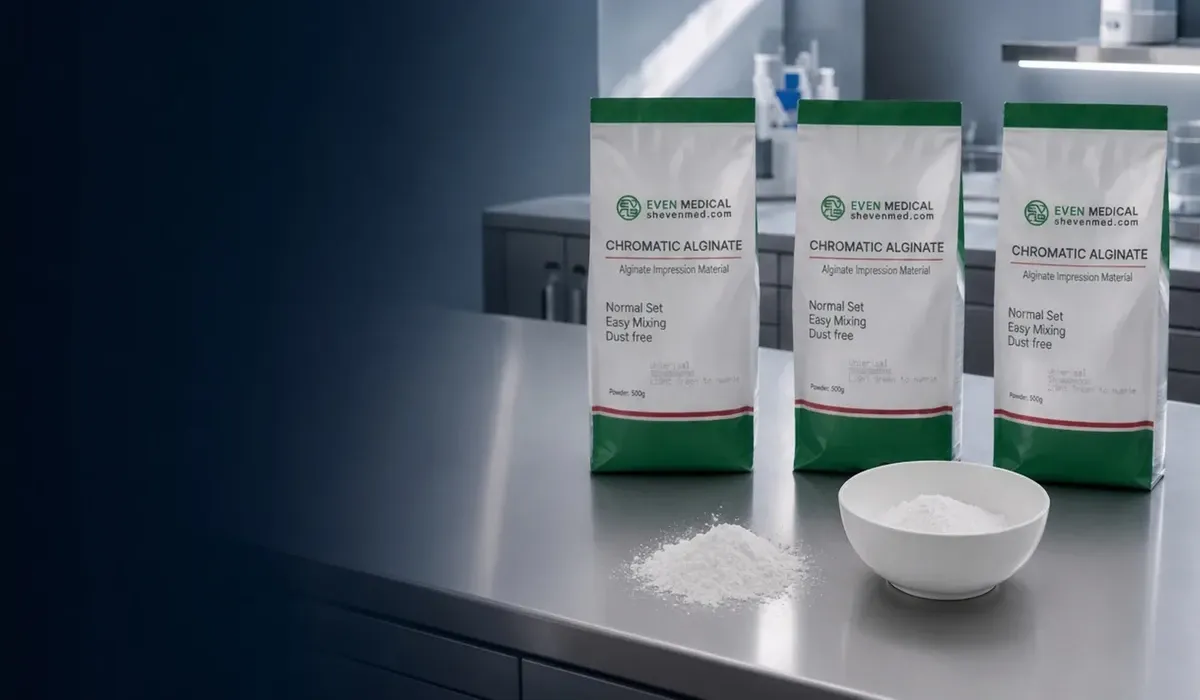
For dental supply distributors and brand owners launching a private-label alginate line, approving pouch artwork is the single most critical gate before commercial production. Once cylindrical rotogravure printing plates or flexographic sleeves are engraved, altering a typo, regulatory mark, or batch code window incurs substantial re-tooling costs and weeks of delay.
Unlike general consumer packaging, dental impression material packaging is tightly regulated. A compliant foil pouch must not only showcase your brand identity but also satisfy international medical device standards (ISO 21563), national customs clearance regulations, and chairside clinical safety requirements.
To avoid costly plate re-engravings and port impoundments, brand managers and procurement leads should audit artwork proofs against this comprehensive pre-press checklist before signing off.
1. Technical & IFU Alignment: Verify Parameters Before Design
The most frequent packaging mistake is copying text from competitor pouches without verifying actual formulation kinetics. Every technical claim on your foil pouch must match the manufacturer's validated Technical Data Sheet (TDS):
- Standardized Setting Benchmark: For universal dental formulations, total setting time must be accurately indicated as approximately 3 minutes (at 23°C / 73°F). Avoid claiming unrealistically fast setting times that lead to clinic complaints.
- Accurate Powder-to-Water Proportion: Specify the validated clinical dosing—typically 10 g powder to 20–22 mL water (or 1 scoop to 1 water measure). Clearly distinguish between metric measures and fluid ounces if exporting to North American or UK markets.
- Shelf Life & Storage Statements: State unopened shelf life strictly as 3 years under temperature-controlled conditions (below 25°C / 77°F, dry, away from direct sunlight). Never invent open-ended tropical warehouse claims.
2. Regulatory & Mandatory Labeling Elements
Customs authorities and health ministries (such as NAFDAC in Nigeria, PPB in Kenya, or SAHPRA in South Africa) routinely inspect imported medical devices for statutory markings. Ensure your design incorporates:
Required Marking | Standard Placement | Compliance Purpose | Audit Check |
|---|---|---|---|
Product Classification | Front lower third & rear header | "Dental Alginate Impression Material (Irreversible Hydrocolloid)" | Clear clinical description |
Net Weight Statement | Front bottom right | 500 g e or 453 g (1 lb) in high-contrast sans-serif font | Verified net quantity |
Batch & Expiry Window | Bottom seal margin or rear flap | Blank unprinted white block (min. 25 × 12 mm) for laser/inkjet coding | LOT: & EXP: fields present |
Single-Use Symbol | Rear instruction box | Standard ISO 7000-1051 symbol (crossed out "2") | Prevents re-use liability |
Storage Temperature Icon | Rear storage section | Temperature limits icon showing <25°C / upper limit | Protects warranty validity |
Manufacturer & Origin | Rear legal footer | "Manufactured for [Brand Name] by Even Medical / Made in China" | Full traceability compliance |
3. Pre-Press & Graphic Production Quality Standards
Rotogravure printing onto multi-layer barrier foil (PET / AL / PE or Matt-BOPP / AL / PE) requires specific graphic tolerances that differ significantly from paper printing:
Minimum Font Sizes and Trapping
- Fine Print Legibility: Regulatory warnings, ingredient disclosures, and distributor details must not fall below 6 pt font size. Fonts below 5 pt on metallic barrier substrates will fill in or bleed under high-speed cylinder impressions.
- Vector Barcodes: Barcodes (EAN-13 or UPC-A) must be vector-generated at 100% scale (minimum 80% truncation). Always print dark solid black or deep navy lines on an opaque white knock-out background. Never print barcode lines on translucent foil or gradient backgrounds.
Color Separation & Plate Count Management
- Spot Colors (Pantone PMS): For precise corporate logo rendering, specify Pantone Matching System (PMS) coated color codes rather than CMYK process simulations.
- White Underprint Layer: Because aluminum barrier foil is naturally reflective, all opaque text, brand logos, and barcode backgrounds require a 100% white ink underprint plate. Verify that your graphic designer has provided a dedicated
Spot_Whitelayer in the vector AI file.
4. The 5-Step Pre-Press Sign-Off Workflow
- Digital Proof Review (1:1 Scale PDF): Print the PDF proof at actual 100% size on a high-resolution color printer. Cut and fold the proof into a mock pouch to verify that critical text does not get caught in top/bottom heat seals or gusset folds.
- Technical IFU Audit: Have your clinical advisor cross-check every word of the mixing instructions, water ratio, and warnings against the manufacturer's official IFU.
- Barcode Scanning Test: Scan the 1:1 paper mock-up with a standard commercial retail barcode scanner to confirm immediate readability.
- Cylinder Layout Approval: Inspect the factory's step-and-repeat cylinder layout drawing to verify eye-mark tracking positions (required by high-speed pouch-filling machinery).
- Signed Digital Sign-Off: Execute written approval with your account manager, noting approved PMS color codes and plate version dates.
Launch Your Private-Label Dental Alginate Line
Algident supports dental distributors worldwide with full-service OEM private labeling. We provide pre-tested foil pouch die lines, regulatory drafting support, and ISO 13485-certified cleanroom packaging for 453 g, 500 g, and 1 kg formats.
- Review packaging formats and private-label terms on our Wholesale & OEM Page.
- Explore batch technical specifications and certifications on our Technology Page.
- Learn about initial trial order requirements in our 720-Bag Trial Order Checklist.
Request Dielines & Private-Label Quotations:
WhatsApp: +86 180 1638 1172 | Email: info@algident.com
Algident · Shanghai Even Medical Instruments Co., Ltd.