Oct 27, 2026Dental Guides
How to Store Alginate: Shelf Life, Temperature & Handling
Alginate storage guide: temperature thresholds (<25°C), humidity control (<50% RH), pre-gelation chemistry, hot-climate warehouse protocols, and clinic operatory handling.
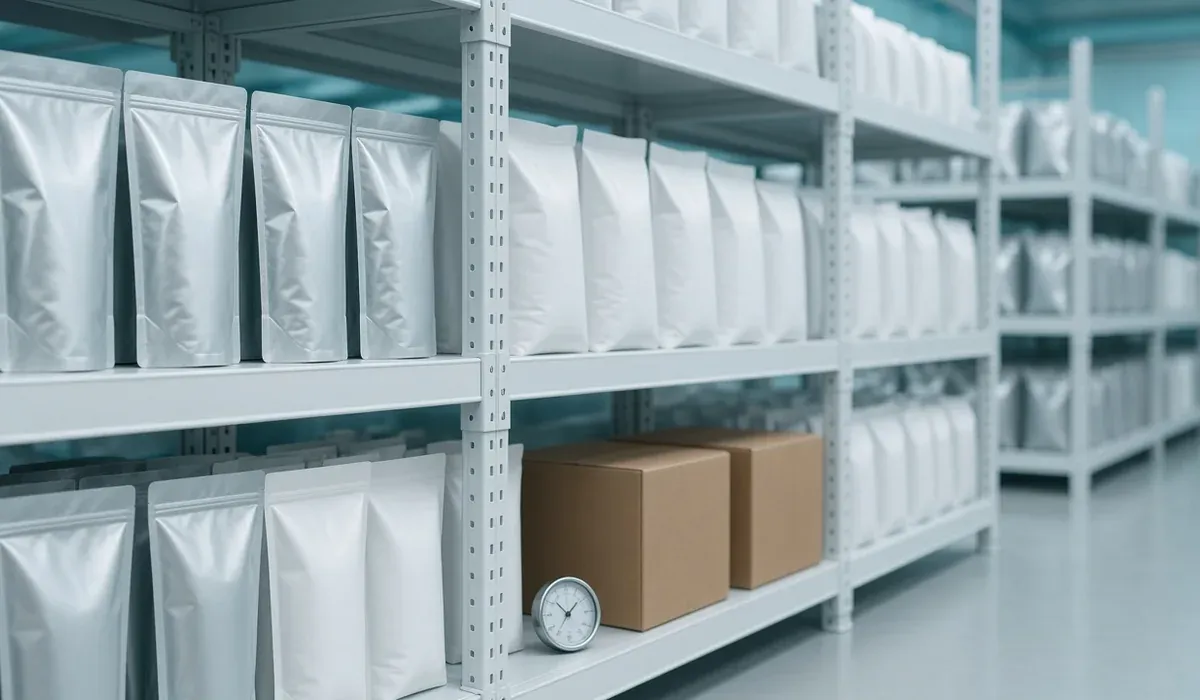
In both high-volume dental supply warehouses and multi-operatory dental practices, alginate powder is frequently mismanaged as an inert, shelf-stable commodity. In reality, dental alginate (an irreversible hydrocolloid system) is an exceptionally moisture-sensitive chemical compound.
The primary active ingredients—soluble potassium or sodium alginate and calcium sulfate dihydrate—depend on precise stoichiometric reaction kinetics triggered solely by the addition of water chairside. When unopened foil bags or bulk clinic canisters are exposed to elevated warehouse temperatures, relative humidity fluctuations, or unsealed operatory air, ambient moisture penetrates the packaging. This initiates low-level premature cross-linking, causing erratic working windows, lumpy mixes, reduced tear strength, and costly chairside remakes.
This operational guide provides dental distributors, warehouse managers, and clinic inventory teams with standard operating protocols for maintaining alginate shelf-life integrity across temperate and hot-climate supply chains.
1. Storage Chemistry: What Happens Inside Compromised Packaging
Understanding why alginate degrades under poor storage conditions clarifies the necessity of strict inventory discipline:
- Premature Hydration & Calcium Ion Release: In environments where ambient relative humidity exceeds 60%, moisture vapor migrates through micro-pinholes or unsealed foil seams. Moisture dissolves minute amounts of calcium sulfate, allowing free ( \text{Ca}^{2+} ) ions to react prematurely with alginate polymers in powder form.
- Insoluble Calcium Alginate Grains: This slow pre-gelation creates micro-nodules within the powder mass. When mixed with water chairside, these pre-reacted grains refuse to dissolve, resulting in a gritty, granular paste that fails to reproduce 20 μm margin details.
- Accelerated Retarder Consumption: High storage temperatures (>30°C / 86°F) accelerate the thermal breakdown of sodium phosphate (the setting retarder). With the retarder depleted in the bag, the powder exhibits severe flash setting—often snapping firm inside the bowl before the assistant can load the impression tray.
2. Technical Storage Specifications & Tolerance Limits
To guarantee that Algident dental alginates deliver their full 3-year unopened shelf life, warehouse and clinical facilities must adhere to international quality benchmarks:
Environmental Factor | Recommended Standard | Critical Warning Threshold | Operational Consequence of Breach |
|---|---|---|---|
Ambient Storage Temperature | 15°C to 25°C (59°F to 77°F) | >30°C (86°F) prolonged | Retarder breakdown, premature setting, rapid expiration |
Relative Humidity (RH) | <50% RH (dry, shaded environment) | >65% RH unsealed | Powder caking, gritty spatulation, loss of tear strength |
Direct Sunlight Exposure | Zero direct UV exposure | Carton / pouch UV irradiation | Localized hot-spot degradation, package embrittlement |
Pallet Floor Clearance | Elevated on pallets (>10 cm) | Cartons resting on concrete slab | Floor dampness migration, carton softening, mold growth |
3. Warehouse Protocol for Hot & Humid Export Markets
Dental distributors operating in tropical regions (including West Africa, Southeast Asia, and the Middle East) face severe logistics challenges during seasonal heat waves. Distributors should enforce these non-negotiable warehouse guidelines:
- Avoid Roof and Exterior Wall Proximity: In non-insulated metal warehouses, temperatures near ceilings and west-facing metal walls frequently exceed 45°C. Store alginate cartons strictly in the center bays on lower racks (first 2 meters from ground level).
- Never Break Moisture-Barrier Foil Until Chairside Use: Algident packs are hermetically sealed inside high-density multi-layer aluminum barrier foil pouches. Bulk outer cartons should remain sealed until dispatched to clinics.
- Strict First-In, First-Out (FIFO) Rotation: Always organize pallet racks with high-visibility lot numbers and manufacturing dates facing outward. Older lots must be dispatched first to prevent stock expiration on back shelves.
- Inspect Inbound Container Seals: Immediately photograph damaged cartons, water marks, or swollen pouches upon container unstripping. Isolate questionable cartons and request batch retain sample testing from the manufacturer.
4. Chairside Handling Rules for Clinic Operatories
At the clinical practice level, improper daily handling is the leading cause of "bad powder" complaints:
- The Canister Decanting Mistake: When pouring powder from a 500 g refill pouch into a plastic operatory canister, never leave the canister lid loose. Dental operatory air contains high aerosol moisture from ultrasonic scalers and handpieces.
- Keep Dispensers Completely Dry: Water droplets on measuring scoops or inside mixing bowls will instantly ruin the top powder layer inside a canister, creating crusty clumping.
- Tightly Reseal Opened Foil Pouches: If using foil pouches directly, fold the open edge over three times and secure with an airtight sealing clip. Use the contents within 30 to 60 days of opening.
- Shake Canisters Before Measuring: During shipping and storage, powder settles and compacts. Lightly shake or invert the container prior to scooping to restore the calibrated bulk density (crucial for consistent powder-to-water weight ratios).
5. Diagnostic Checklist for Storage-Induced Powder Defects
Observed Defect | Physical Test | Root Cause Diagnosis | Action Required |
|---|---|---|---|
Powder caked into solid clumps | Sifting resistance / hard lumps | Extreme moisture ingress during storage | Quarantine lot; do not sift and use |
Flash setting (<60 seconds in bowl) | Temperature-controlled mix test at 20°C | Severe heat exposure depleted retarder | Retire batch from crown/bridge diagnostics |
Rough, sandpaper model surface | Microscopic plaster cast audit | Insoluble pre-gelled alginate nodules | Review operatory canister sealing practices |
Elastic tear along thin margins | Tensile pull test during extraction | Hydrolytic cleavage of alginate chains | Check warehouse humidity records |
Technical Support & Batch Retention Testing
Algident maintains batch retention samples under ISO-certified climate-controlled conditions for every export production run. If your distribution team or client clinics experience unexplained setting deviations, our technical lab will evaluate retain samples against your batch lot number to verify physical parameters.
- Explore standard specifications and certification data on our Technology & Quality Control page.
- Review bulk packing options, container pallet layouts, and export terms on our Wholesale & OEM Page.
- For distributor inquiries, container shipping schedules, or technical data sheets (TDS), Contact Our Technical Export Team.
Export Inquiries & Batch Retain Verification:
WhatsApp: +86 180 1638 1172 | Email: info@algident.com
Algident · Shanghai Even Medical Instruments Co., Ltd.