Oct 28, 2026Dental Guides
Alginate Mixing Guide: Ratios, Water Temperature & Working Time
Master alginate mixing: powder-to-water ratios (10g:20-22mL), water temperature kinetics, power spatulation shear technique, and troubleshooting chairside defects.
Getting the Mix Right Every Time
Alginate forgives almost nothing at the mixing stage: the ratio, the water temperature and the mixing technique all show up in the final impression. This guide covers the numbers, the workflow and the most common failures.
THE TWO STANDARD RATIOS
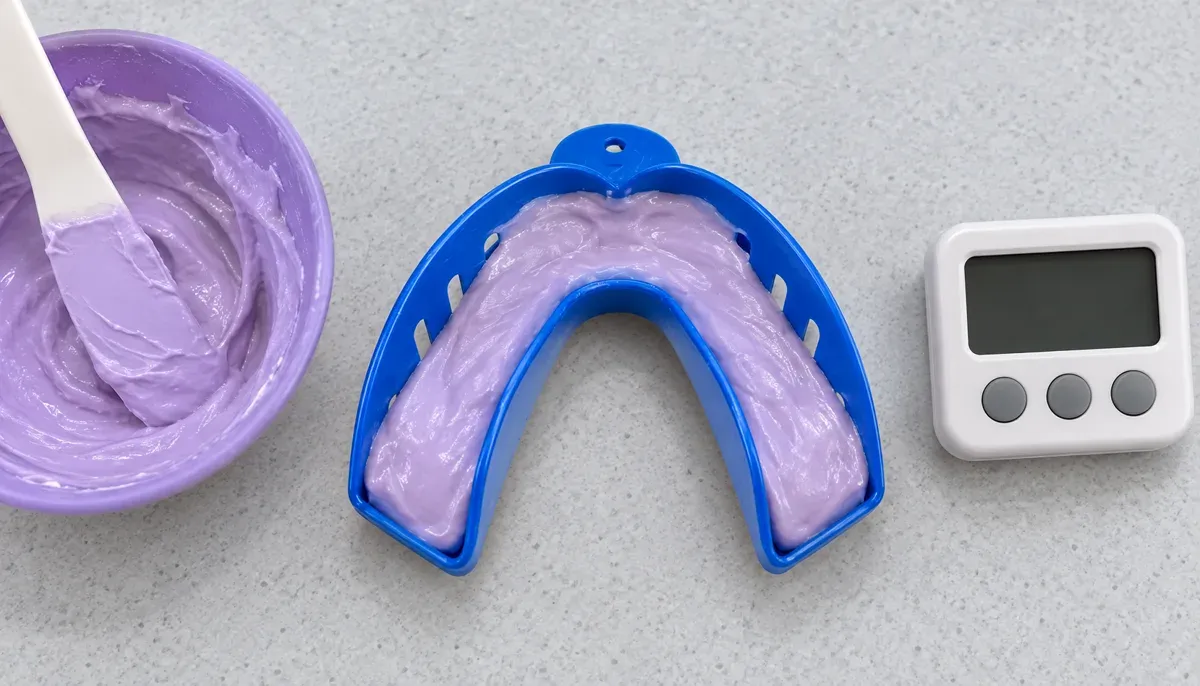
Dental impressions: 10g powder to 20ml water (1:2). Approximately 30 seconds of mixing, approximately 1 minute 30 seconds of working time, approximately 1 minute of intraoral setting.
Life casting: 100g powder to 300–400ml water (1:3 to 1:4). More water gives a softer mix and slightly longer working time.
WATER TEMPERATURE RULES
- Below 30°C for life casting: warm water accelerates setting and shortens your working window.
- Room-temperature water for dental work: consistent timing matters more than speed.
- Cold water slows setting: useful in hot climates, but do not exceed the ratio.
STEP-BY-STEP WORKFLOW
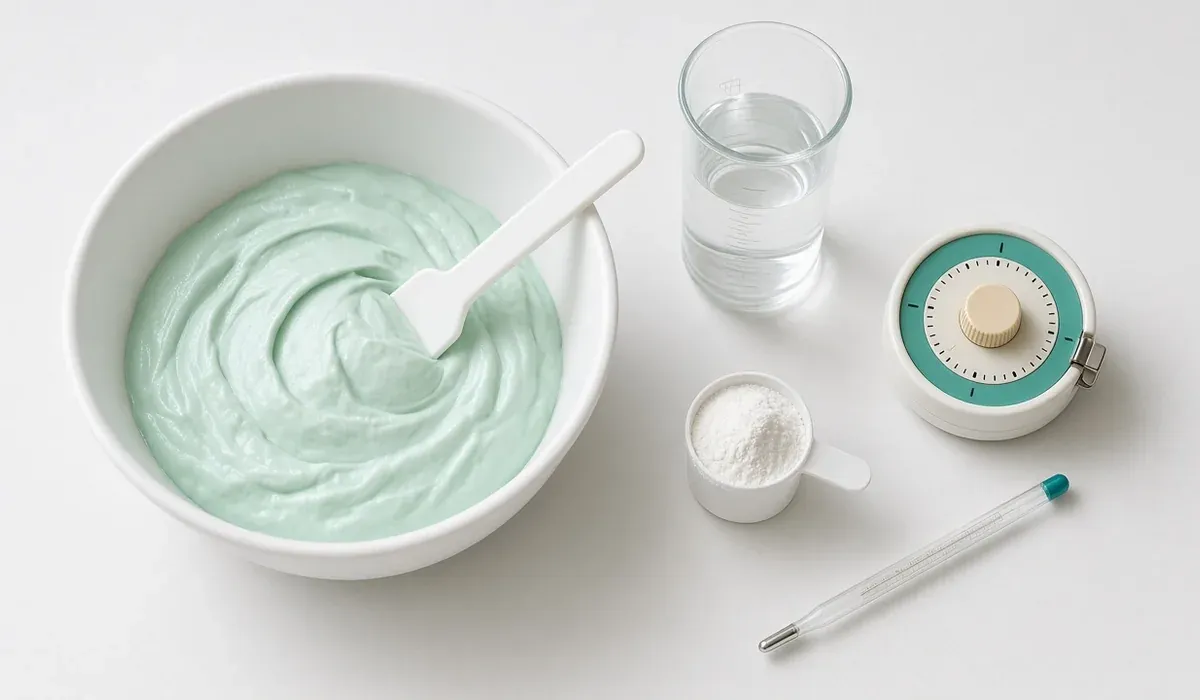
- Dose the powder and water precisely — a scale beats scoops.
- Mix vigorously for 30 seconds to a smooth, lump-free consistency.
- Load the tray, seat and hold still until fully set.
- With chromatic alginate, follow the color cues: mix color, loading-window color, set color.
COMMON FAILURES AND FIXES
- Grainy, weak mix: too much water or under-mixing — dose precisely and mix the full 30 seconds.
- Set too fast: warm water or hot weather — use cooler water and work faster.
- Distorted detail: removed too early or moved during set — wait for the full set indication.
STORAGE AND HANDLING
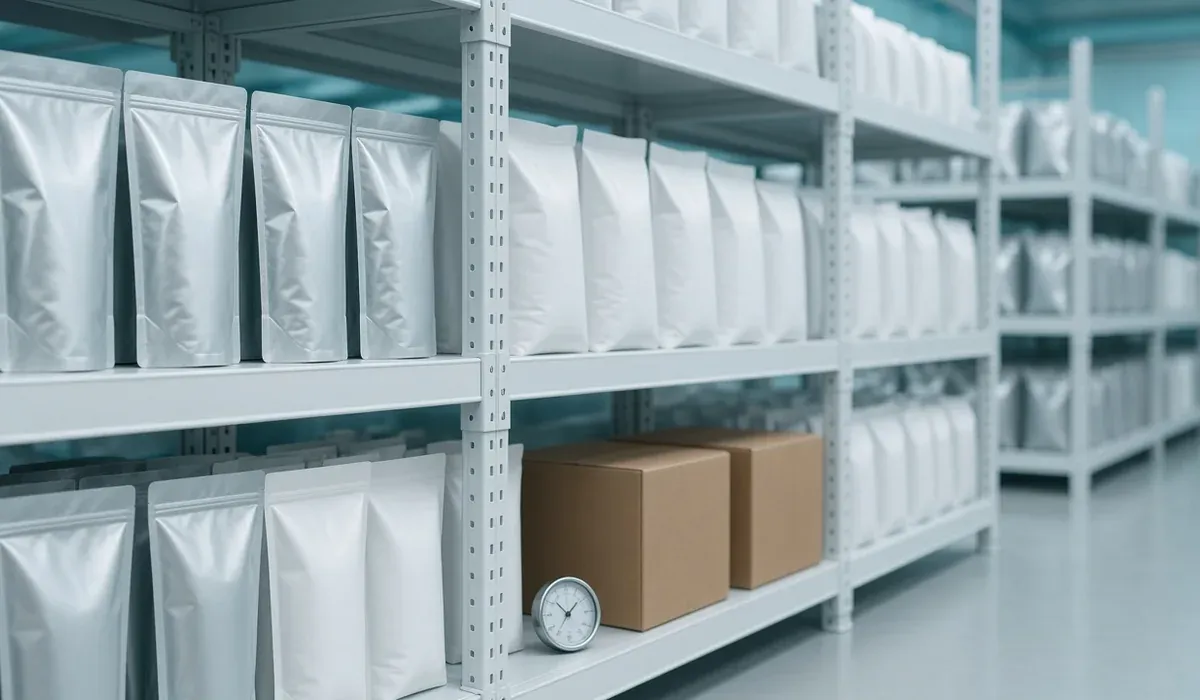
Sealed bags, below 25°C, dry. Shelf life 3 years unopened. Once mixed, alginate cannot be stored — plan your workflow around the working time.
QUESTIONS ON RATIOS OR BATCH DATA?
Contact Algident via WhatsApp +86 180 1638 1172 or email info@algident.com — TDS and batch COA available for every grade.In both fast-paced dental operatories and commercial life casting studios, impression failures are overwhelmingly attributed to "inconsistent powder." In clinical reality, irreversible hydrocolloid chemistry is remarkably predictable: the reaction between soluble alginate and calcium sulfate dihydrate is governed strictly by the water-to-powder ratio, spatulation shear energy, and ambient liquid temperature.
Slight deviations—such as eye-balling scoop levels, using warm summer tap water, or stirring past the working window—drastically distort gelation kinetics. This leads to premature setting in the bowl, rough granular textures, tearing along delicate margin lines, and uncomfortable patient remakes.
This clinical guide provides dental assistants, clinic procurement heads, and life casting technicians with standardized mixing protocols, temperature compensation tables, and diagnostic troubleshooting steps to achieve repeatable, bubble-free impressions on every chair.
1. Dosing Discipline: Weight vs. Volumetric Measurement
The foundation of a smooth, bubble-free hydrocolloid mix begins before the spatula touches the bowl:
The Volumetric Compaction Trap
Measuring powder with plastic volumetric scoops is standard practice, but powder settles and compacts during shipping and shelf storage. A packed scoop can weigh up to 25% more than an aerated scoop, drastically lowering the effective water ratio and accelerating gelation.
- The Standard Dental Proportion: The universal clinical benchmark is 10 g of powder to 20–22 mL of room-temperature water (approximately 1:2 to 1:2.2 by weight). For an average adult quadrant or full-arch tray, calibrate to 2 scoops (~20 g) and 40–44 mL water.
- The Life Casting Proportion: For skin casting and hand molds, the formulation requires extended fluidity to capture fine dermatological lines. Calibrate to 1:3 to 1:3.5 by weight (e.g., 100 g powder to 300–350 mL water) as specified on the batch IFU.
- Best Practice Protocol: Always lightly invert or shake the storage canister prior to scooping to fluff the powder. Level each scoop flat across the rim with a straight-edged spatula without packing it down.
2. Water Temperature: The Master Catalyst of Setting Kinetics
Water temperature is the single most influential variable affecting alginate working time and total setting time.
Alginate setting is an ionic exchange reaction. As water temperature increases, the solubility rate of calcium sulfate rises, releasing ( \text{Ca}^{2+} ) ions more rapidly to cross-link the alginate polymers.
Water Temperature | Working Time Impact | Total Setting Time (Universal) | Clinical / Studio Recommendation |
|---|---|---|---|
Cold (15°C – 18°C / 59°F – 64°F) | Extended (+30 to 45s) | ~3 min 45s | Recommended for hot summer clinics, large complex quadrant trays, or anxious pediatric patients |
Standard (20°C – 23°C / 68°F – 73°F) | Calibrated Standard (~60s) | ~3 min 00s | Universal baseline (IFU benchmark for Algident Universal Dental Alginate) |
Warm (24°C – 28°C / 75°F – 82°F) | Drastically Shortened (-30s) | ~2 min 15s | High risk of premature gelation inside the mixing bowl; leads to shear fractures |
Hot (>30°C / 86°F) | Flash Setting (<30s) | <1 min 30s | Severe failure mode: Paste tears during tray loading or seating; unusable |
Pro Tip for Tropical & Summer Clinics: Never rely on ambient tap water during summer months when plumbing pipes run warm (>26°C). Keep a sealed pitcher of distilled or purified water inside a clinic refrigerator (chilled to ~15°C) to maintain consistent 3-minute setting times throughout the day.
3. Step-by-Step Spatulation Technique: Eliminating Air Voids
Even correctly measured powder can yield porous impressions if spatulation lacks sufficient shear force. Follow this standardized four-step chairside procedure:
- Water First, Powder Second: Always dispense the measured water into a clean, dry, flexible rubber bowl before adding the powder. This allows the liquid to surround the particles, preventing dry powder from clinging stubbornly to the bottom curve.
- Phase 1 – Initial Wetting (10–15 Seconds): Use the tip of the curved spatula to gently stir in figure-eight loops until all dry powder is wetted into a loose slurry. Do not whip air into the bowl during this phase.
- Phase 2 – Power Spatulation (25–30 Seconds): Hold the bowl firmly in one hand and tilt it at a 45-degree angle. Press the flat edge of the spatula firmly against the curved inner sidewall of the bowl, rotating the bowl continuously. This high-shear smearing motion forces trapped air bubbles to collapse and dissolves all microscopic powder nodules into a creamy, mirror-smooth paste.
- Phase 3 – Tray Loading & Smoothing (15–20 Seconds): Gather the paste in one or two sweeps. Load the perforated impression tray from the posterior aspect forward to push air outward. Moisten a gloved finger with cold water and lightly wipe the paste surface to smooth the contour before seating intraorally.
4. Diagnostic Troubleshooting Matrix for Mixing Defects
Observed Defect | Probable Root Cause | Corrective Action |
|---|---|---|
Gritty, grainy texture with dry specks | Added water on top of powder, or insufficient bowl sidewall spatulation | Dispense water first; press spatula flat against bowl walls with firm pressure |
Paste sets in bowl before tray is seated | Water temperature too warm (>24°C), or assistant stirred past 45 seconds | Check water with digital thermometer; use chilled water (18°C); strictly observe timing |
Torn margins & delaminated layers | Tray was inserted after alginate initiated gelation (fibril tearing) | Discard mix; seat tray immediately upon loading while surface remains glossy |
Permanent drag / distorted occlusal anatomy | Premature tray removal before full elastic recovery | Wait full 60–90 seconds post-gelation (total time ~3 min) before vertical extraction |
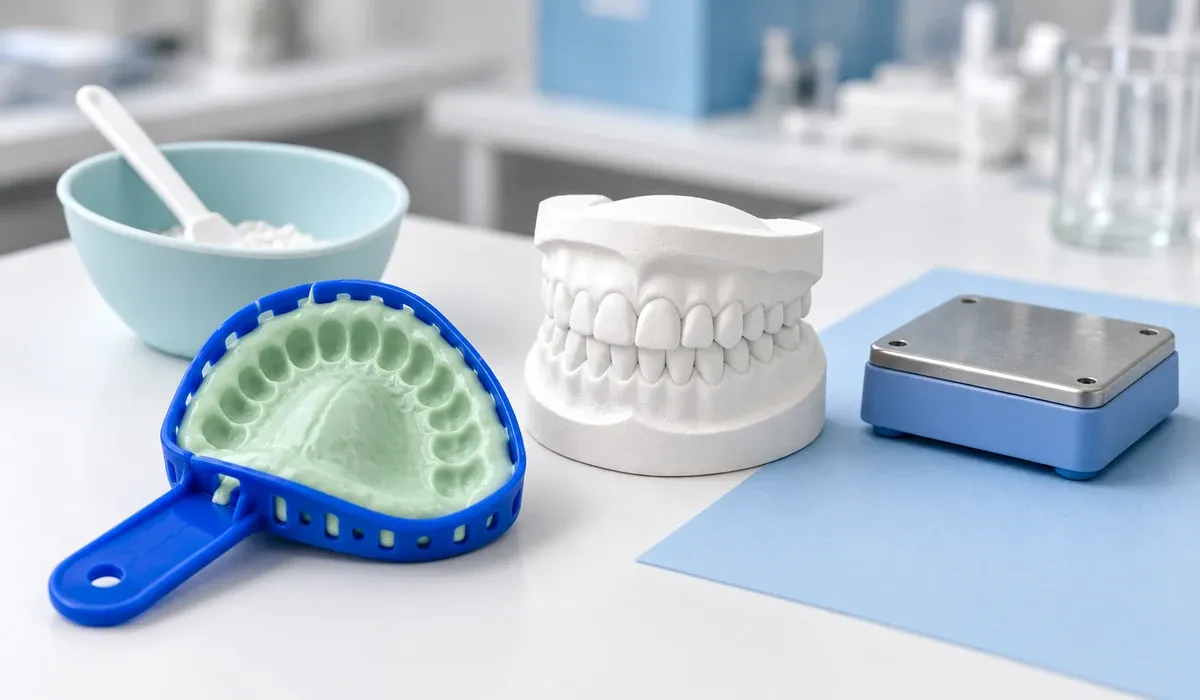
Chalky, soft stone model surface | Delayed stone pouring, standing water in impression, or incompatible gypsum | Drain excess rinse water; pour Type III/IV stone within 15–30 minutes |
Studio & Practice Support: Requesting Batch Technical Data
Algident formulates dust-free, lead-free Universal, High Precision, and Chromatic dental impression powders calibrated to ISO 21563 international standards. Every export carton is accompanied by batch-certified Certificate of Analysis (COA) documentation detailing exact lot setting kinetics.
- Review complete grade specifications on our Algident Technology Page.
- Learn how chromatic phase cues cut remakes in our Chromatic Alginate Clinical Guide.
- Review bulk drum and private-label packaging options in our Wholesale & OEM Section.
Contact our technical export specialists for sample cartons and TDS documentation:
WhatsApp: +86 180 1638 1172 | Email: info@algident.com
Algident · Shanghai Even Medical Instruments Co., Ltd.