Oct 29, 2026
Evaluating an Alginate Sample: A Feedback Sheet for Distributors and Clinics
A structured 5-stage clinical evaluation framework and scorecard for dental distributors testing alginate samples across clinic trials before placing volume orders.
Requesting sample cartons is standard procedure when a dental supply distributor evaluates a new alginate manufacturer. Yet all too often, distributor sales reps simply drop sample pouches at a few friendly clinics and ask casually, "How did the powder feel?"
Vague verbal impressions like "It was fine" or "A bit sticky" give procurement managers zero actionable data. Did the assistant measure with calibrated water? What was the operatory room temperature? Did the stone model pull cleanly from undercuts?
Without a standardized clinical evaluation protocol, distributors risk rejecting superior formulations due to improper chairside technique, or placing substantial container orders for powders that fail under high-volume clinical pressure.
This guide provides dental supply distributors, clinic procurement heads, and lead dental nurses with a practical, objective 5-stage clinical evaluation framework and a printable audit sheet.
1. Why Sample Testing Requires Structured Chairside Controls
Dental alginate is a responsive ionic chemical system. Subtle handling variables create massive perceptual differences:
- The Ambient Temperature Variable: Running a trial in a hot afternoon operatory (27°C / 81°F) without recording water temperature will cause standard powder to set in less than 2 minutes, leading dentists to complain of "unusable flash setting."
- The Dosing Inaccuracy: Assistants accustomed to light, fluffy scoops may accidentally pack dense, settled trial powder, skewing the powder-to-water ratio by up to 25%.
- The Gypsum Incompatibility: Some dental stones react poorly with certain hydrocolloid retarders, producing a chalky surface that has nothing to do with impression tear strength.
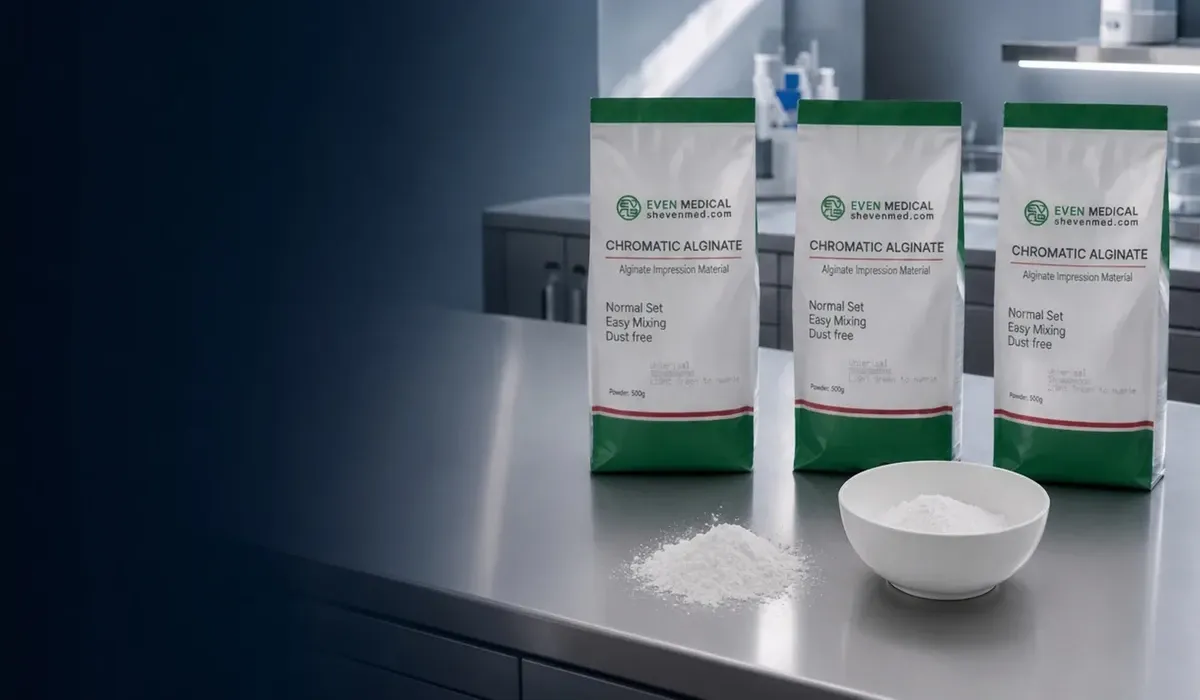
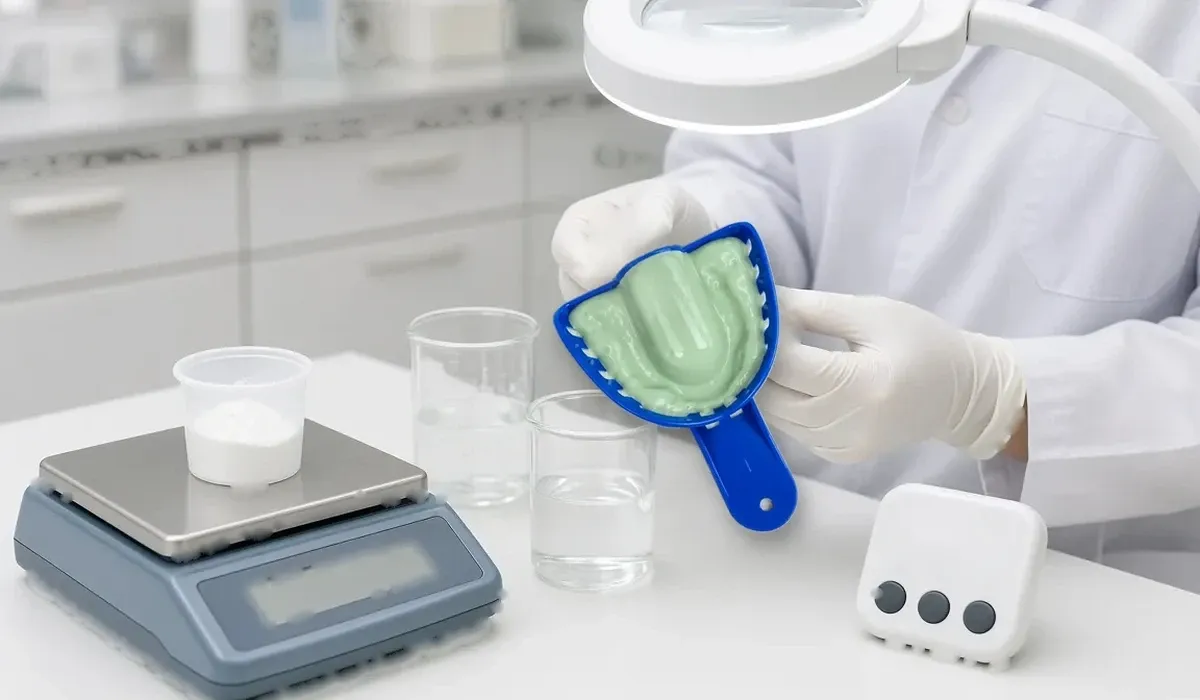
Distributors should provide trial clinics with an official Sample Evaluation Protocol Kit: 2 sealed foil pouches (500 g), a calibrated water cylinder, a straight-edged leveling spatula, and this feedback audit sheet.
2. The 5-Stage Clinical Audit Framework
Have your testing clinic run the sample across at least 5 distinct patient cases (including quadrant study casts, full-arch orthodontic baselines, and opposing dentition) and score each parameter:
Stage 1: Foil Packaging & Dispensing (Weight & Dust Level)
- Hermetic Seal Integrity: Check that the multi-layer aluminum barrier foil is intact with no pinholes or soft seals.
- Dust-Free Performance: Dispense two scoops into the mixing bowl. Note whether airborne particulate float is eliminated (critical for assistant respiratory comfort and clean operatory air).
- Powder Fluidity: Audit the powder texture for dry clumping or caking.
Stage 2: Spatulation & Hydrophilic Wetting
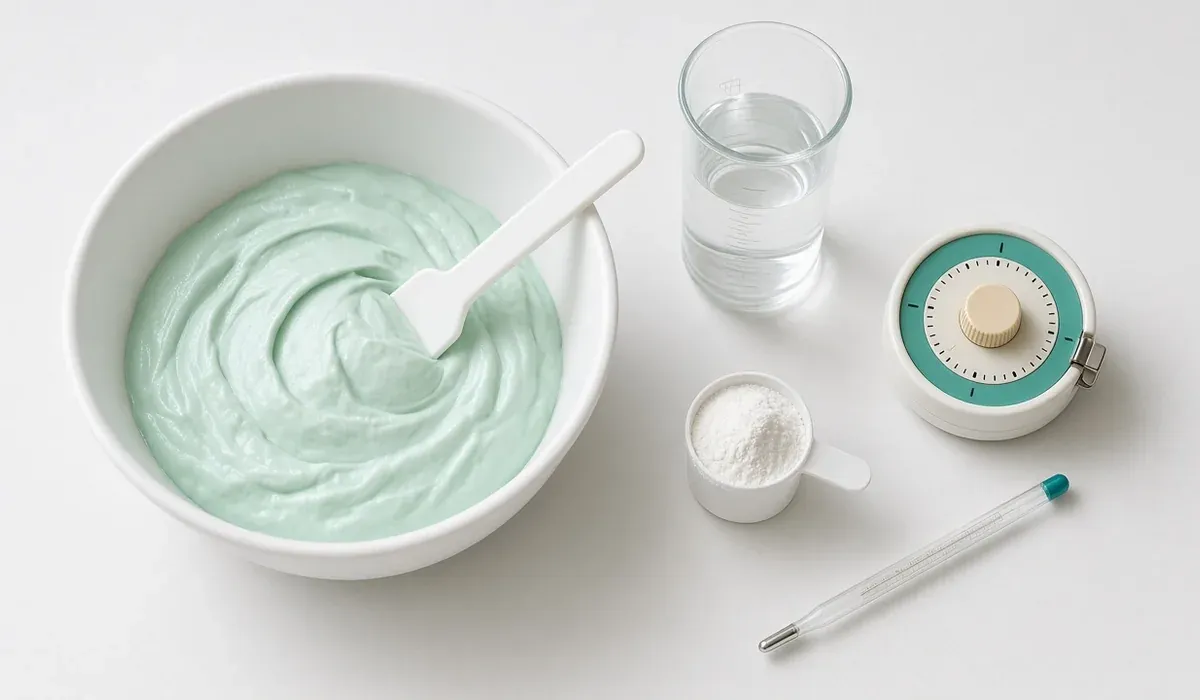
- Calibrated Water Mix: Measure strictly 10 g powder to 20–22 mL water (at 20°C–23°C / 68°F–73°F).
- Wetting Speed: How quickly does the powder absorb water upon initial figure-eight stirring? (Target: <15 seconds).
- Homogeneity: Under vigorous bowl sidewall spatulation, does the paste transform into a smooth, creamy, bubble-free consistency within 30 to 40 seconds?
Stage 3: Working Time, Viscosity & Tray Loading
- Body & Slump Resistance: When gathered on the spatula, does the alginate hold a stable body without slumping off the tray edges, while maintaining sufficient hydraulic flow?
- Intraoral Seating Window: Does the material remain glossy and compliant while seating the tray?
- Patient Comfort: Is the flavor (mint/neutral) well tolerated without mucosal stinging or chemical odor?
Stage 4: Gelation Kinetics & Elastic Recovery
- Snap Set Behavior: Does the hydrocolloid transition cleanly from paste to gel rather than lingering in a sticky intermediate phase?
- Universal Setting Benchmark: Total setting time from start of mix should calibrate to approximately 3 minutes under 20°C–23°C conditions.
- Undercut Resistance: Upon vertical extraction, does the set impression flex smoothly past deep interdental undercuts without tearing (elastic recovery 97%–98%)?
Stage 5: Gypsum Pouring & Model Surface Fidelity
- Pour Window Discipline: Rinse mucosal saliva, disinfect, and pour Type III or Type IV stone within 15 to 30 minutes (preventing syneresis shrinkage).
- Stone Separation: Does the hardened model release cleanly from the impression without gypsum sticking to the alginate?
- Surface Hardness & Margin Detail: Inspect the dental cast under operatory lighting. Are occlusal pits, gingival margins, and line angles razor-sharp down to 20 μm without chalky chalkiness?
3. Printable Clinic Evaluation Scorecard
Distributor reps should print this evaluation matrix for each participating clinic:
Evaluation Parameter | Target Clinical Standard | Clinic Rating (1–5 Stars) | Assistant / Dentist Notes |
|---|---|---|---|
1. Dust-Free Dispensing | Zero airborne dust plume during scooping | [ ] [ ] [ ] [ ] [ ] | |
2. Spatulation Ease | Smooth, bubble-free paste in <40s | [ ] [ ] [ ] [ ] [ ] | |
3. Tray Stability | Good thixotropy; does not slump into throat | [ ] [ ] [ ] [ ] [ ] | |
4. Working Window | ~60s working time; glossy tray seating | [ ] [ ] [ ] [ ] [ ] | |
5. Setting Time | Total setting ~3 min at 20°C–23°C | [ ] [ ] [ ] [ ] [ ] | |
6. Elastic Recovery | Clean extraction without tearing in undercuts | [ ] [ ] [ ] [ ] [ ] | |
7. Patient Tolerance | Pleasant, mild mint; no gagging reflex | [ ] [ ] [ ] [ ] [ ] | |
8. Model Surface | Hard, glass-smooth stone; crisp 20 μm margins | [ ] [ ] [ ] [ ] [ ] | |
Overall Recommendation | [ ] Highly Recommend [ ] Acceptable [ ] Reject | Evaluator Signature: | Date: |
4. Translating Feedback into Commercial Purchase Orders
Once 3 to 5 trial scorecards are returned with an average rating of 4.2 stars or above, distributor purchasing teams can proceed with confidence:
- Verify Batch-to-Batch Consistency: Cross-reference the sample pouch lot number with the factory's batch Certificate of Analysis (COA) to confirm that physical test values (compressive strength >0.5 MPa, detail reproduction 20–50 μm) match production baselines.
- Start with a Confirmed Trial Volume: For first-time imports, standardizing on a 720-Bag Trial Order Checklist allows you to test commercial supply chain logistics before committing to 20-foot full container loads.
- Structure Your Grade Portfolio: Align initial stock between high-volume universal demand and premium restorative clinics using our guide on Choosing an Initial Dental Alginate Grade Mix.
Request Evaluation Sample Cartons for Your Distribution Territory
Algident provides international dental distributors with complimentary sample boxes containing our Universal, High Precision, and Chromatic formulations, complete with batch TDS documentation and dieline templates.
- Review certified technical specifications on our Algident Technology Page.
- Explore customized foil branding, carton labeling, and container terms on our Wholesale & OEM Page.
- Learn about proper warehouse climate control in our Alginate Storage & Shelf-Life Guide.
Request Sample Cartons & Factory Direct Quotations:
WhatsApp: +86 180 1638 1172 | Email: info@algident.com
Algident · Shanghai Even Medical Instruments Co., Ltd.