Oct 30, 2026Dental Guides
Gypsum Stone Compatibility with Alginate Impressions: How to Prevent Chalky Casts
How dental clinics and labs prevent chalky or soft Type III/IV gypsum stone surfaces on alginate impressions: mucin removal, matte-moist drying, and 45-60 min separation.
Even when a dental assistant captures a sharp, bubble-free alginate impression with
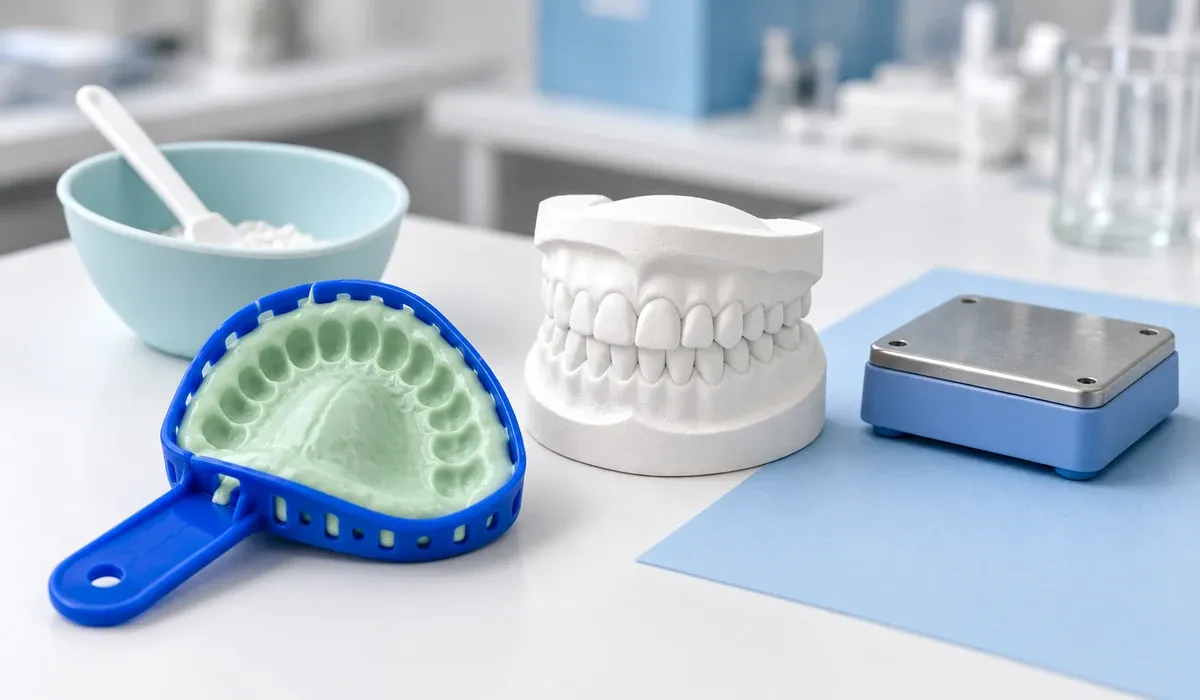
20 μm marginal detail, the final diagnostic or working model can still fail in the laboratory if the poured Type III or Type IV gypsum stone emerges with a soft, chalky, or powdery surface.Clinics and labs often assume a chalky stone surface is caused by “incompatible alginate powder” or “bad gypsum.” In reality, surface softness at the hydrocolloid-gypsum interface is almost always caused by free surface water dilution, unrinsed organic mucin, or leaving the stone cast locked inside the drying alginate too long. This technical guide explains the chemistry at the interface and provides a 5-step laboratory SOP for crisp, hard stone models every time.
1. Diagnostic Matrix: Why Gypsum Casts Turn Soft or Chalky Against Alginate
When calcium sulfate hemihydrate (dental stone) hydrates into calcium sulfate dihydrate crystals, the reaction right against the alginate wall is highly sensitive to excess liquid and organic retarders:
Surface Defect on Stone Cast | Root Physical / Chemical Cause | Immediate Corrective Action |
|---|---|---|
Chalky, powdery incisal edges & cusp tips | Pooled rinse water or disinfectant droplets trapped in deep tooth recesses increased the local water-to-stone ratio ( W/P) | Shake tray firmly and blot cusp depressions with a gentle air stream or lint-free tissue until matte-moist (no standing puddles) |
Gummy, unhardened patches across palatal vault | Residual saliva mucin or blood proteins acted as a chemical retarder against gypsum crystal interlocking | Rinse impression immediately after removal under cool tap water (or dust lightly with stone powder and rinse) to strip mucin film |
Pitted craters along gingival margins | Vibration frequency too high or stone added too rapidly, trapping air bubbles in undercuts | Flow small increments of vacuum-mixed stone from one molar tuberosity around the arch under low-amplitude vibration |
Fractured stone teeth or desiccated white crust | Delayed separation ( >90 minutes or overnight): drying alginate shrinks and extracts water of crystallization from the stone | Separate the gypsum cast from the alginate impression strictly within 45 to 60 minutes of pouring |
Rough, grainy model reproduction | Incorrect chairside alginate mixing ( <10 g : 20–22 mL water or incomplete spatulation leaving dry particles) |
(For chairside distortion and tearing issues before the impression reaches the lab bench, see Alginate Impression Remakes: 7 Causes Clinics Blame on “Bad Powder”.)
2. The 5-Step Chairside-to-Lab Pouring Protocol for 20 μm Stone Models
All Algident dental grades—Universal (
~3 min total set, >0.5 MPa), High Precision (>0.55 MPa), and Super High Precision (>0.6 MPa, 98% elastic recovery)—are formulated for direct compatibility with standard Type III orthodontic stone and Type IV low-expansion die stone when technicians follow five rules:Step 1: Strip the Saliva Mucin Film Immediately
Saliva contains mucopolysaccharides that coat the hydrogel surface and inhibit gypsum crystallization. Within seconds of snapping the set impression from the patient’s mouth:
- Rinse gently under cool running tap water for
5–10 seconds.
- Thick Saliva Tip: If the patient has viscous ropey saliva, lightly dust a pinch of dry dental stone powder over the wet impression surface; the powder binds the mucin so a second gentle water rinse flushes it away cleanly.
Step 2: Disinfect Without Prolonged Soaking (Prevent Imbibition)
Never submerge an alginate impression in a liquid disinfectant tub for extended periods—the hydrogel absorbs water (imbibition), swells dimensionally, and exudes free liquid onto the stone during pouring.
- Spray the rinsed impression thoroughly with an approved clinic surface disinfectant.
- Seal inside a
100% relative humidityplastic bag for the disinfectant’s specified contact time (typically 10 minutes), then briefly rinse if required by the disinfectant IFU.
Step 3: Achieve a “Matte-Moist” Surface Before Pouring
This is the single most important step to prevent chalky stone:
- Shake the perforated tray briskly to fling bulk water out of molar and incisor sockets.
- Use a gentle, oil-free compressed air syringe (or absorbent paper point) to clear every visible droplet from deep occlusal fissures.
- Visual Check: The alginate surface should look satin/matte-moist like a wrung-out sponge—never shiny with standing water puddles, and never dried out.
Step 4: Pour Within 15–30 Minutes Using Weighed Gypsum
Just as alginate requires an exact
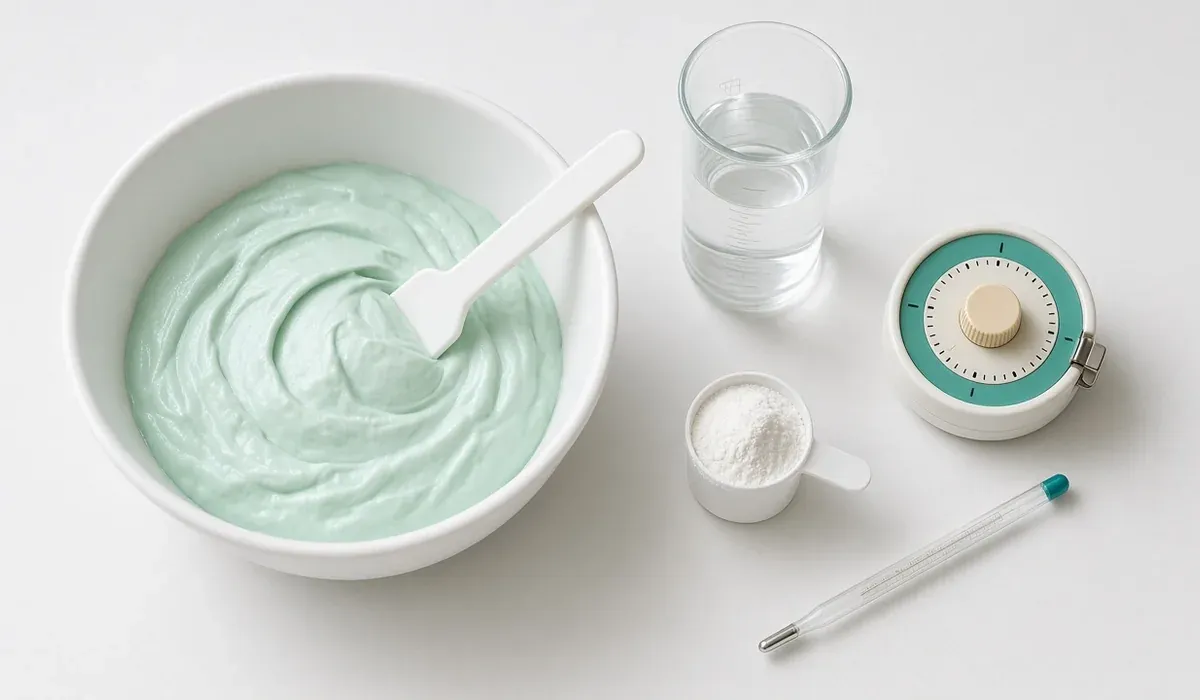
10 g : 20–22 mL ratio, Type III and Type IV dental stones require exact weighed powder and measured water (typically 22–30 mL per 100 g of stone—always follow the gypsum manufacturer’s IFU):- Place the tray handle on a mechanical dental vibrator at low amplitude, high frequency.
- Apply a small increment of stone at one posterior molar region and watch the leading edge flow smoothly across the arch through the interproximal spaces to the opposite molar before building up bulk thickness.
Step 5: Demold at 45–60 Minutes (The Golden Separation Window)
Leaving a poured alginate impression on the bench for several hours—or overnight—ruins both surface hardness and tooth survival:
- Once gypsum completes its initial exothermic setting (
45–60 minutes), remove the alginate tray cleanly.
- If left beyond
90 minutes, the losing-water alginate stiffens rigidly around delicate stone incisors and draws moisture back out of the stone surface.
3. How Distributors Can Use Gypsum Compatibility in Clinic Trials
When dental distributors supply evaluation pouches to prospective clinics or prosthodontic labs, pairing our Clinic Sample Evaluation Feedback Sheet with our Complete Alginate Workflow Guide ensures that technicians judge the sample on a properly poured stone model rather than an over-wetted cast.
- Compare full grade specifications in Dental Alginate Grades Explained and Alginate vs. Silicone Impression Material.
- Protect unopened warehouse stock (
3-yearshelf life below25°C) with our Alginate Storage & Shelf-Life Guide.
Request Factory Samples & Technical Documentation
Explore our full specification tables on the Algident Technology Page or review bulk distributor terms on our Wholesale & OEM Page.
Contact our Shanghai export desk for samples, COA/SDS files, and wholesale quotes:
WhatsApp: +86 180 1638 1172 | Email: info@algident.com | Request a Quote Online
Algident · Shanghai Even Medical Instruments Co., Ltd.